What Motorized Shades Cost in Avon and Where They Pay
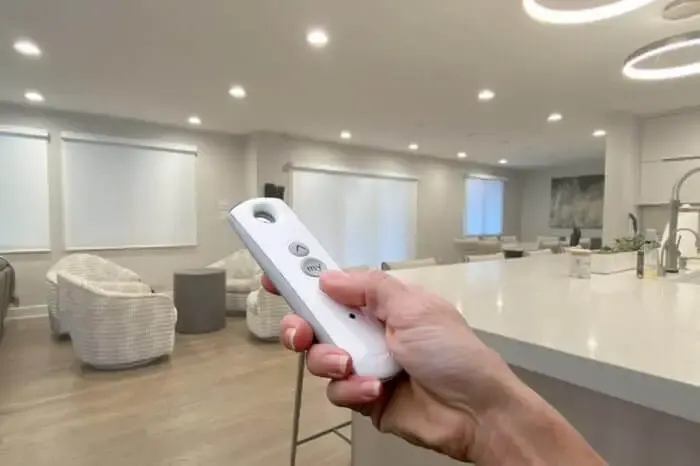
Motorization is the single biggest optional line on most window treatment quotes, and it's the one where the price spread makes the least sense from outside. Two shades that look identical can differ by hundreds of dollars because of how the motor gets power. Here's what actually drives the cost on an Avon job, what the first quote usually leaves out, and which openings return the money and which ones quietly don't.
The number, and what sits under it
Nationally, a motorized shade runs roughly $300 to $1,500 a window installed. That range covers everything from a small battery powered cellular shade to a wide hardwired blackout roller on a two story wall, which is why it's so wide. Size and fabric move you within that range, and so does the way the motor gets its power.
That last one is the lever most people don't know they have. Battery motors run roughly $100 to $300 a window less than hardwired ones. On six openings that's a meaningful difference, and on a whole floor it's the difference between doing the project now and putting it off. The catch is that you're trading a one time cost for an ongoing task, which is a fair trade in some houses and a bad one in others.
Where the money is wasted
A small bathroom window you adjust twice a year does not need a motor. Neither does a closet, a laundry room, or a shade you keep down permanently for privacy. Motorizing a whole Avon house because it seems more consistent is the most common way people overspend on this. A mixed house, where the tall and awkward openings are motorized and the rest are cordless, is what most well planned jobs look like.
Skip the schedule if you're home all day and you'd rather press a button. That saves the hub and the setup. Direct remote systems also age better in one specific way: they don't depend on an app, a network or a company continuing to support a phone platform.
Where motorization actually pays back
Think about it as buying behavior, not convenience. A shade you can move without getting up is a shade that gets used, and a shade that gets used does the job you bought it for. That's where the value hides.
High openings are the clearest case. Anything above eight feet, a stairwell, a transom over a door: hand operation there means a pole or a ladder, so those shades sit in one position for years. Motorize them and they start earning their keep against afternoon heat and glare. Two story great rooms are common in newer Avon construction, and those upper shades are exactly the ones that otherwise never get touched. The second clear case is a room with a wall of glass, where four or five shades should move as one. Nobody makes five trips. They make zero, and the shades stay wherever they were left.
The third is accessibility, and it's the one that justifies the cost fastest for anyone with limited reach or mobility. A wall switch or a phone beats a cord in a way that isn't about luxury at all.
Warranty and who fixes it
Motorized shades have two warranties riding along, and they're rarely the same length. The fabric and mechanism warranty covers the shade. The motor and electronics warranty covers the moving part, and it usually runs shorter. Ask for both in writing, and ask a plainer question on top: who comes out when a motor fails in year three, and is the labor covered or only the part?
That's the real difference between buying a motorized shade from a company that measures and installs and buying one online. A motor is a mechanical thing that eventually stops. When the installer holds the account with the manufacturer, the claim goes through them and somebody shows up. When you bought it yourself, you own the phone call, the shipping and the reinstall.
The costs that don't appear on the first quote
- Batteries over time. Hunter Douglas publishes about a year of battery life for PowerView, and heavier shades on daily schedules run shorter. Rechargeable wands cost time rather than money. Alkaline packs cost money on a recurring basis.
- The hub. A direct remote costs nothing extra beyond the remote. Schedules, phone control and voice all require a hub or bridge, and that's a separate line.
- Repeaters. Big houses and masonry interiors eat radio range, and a far corner may need one.
- Electrical work. Hardwiring means low voltage runs and a power supply, which is a trade you're hiring on top of the shade order.
- Remote batteries and spare remotes. Small, but they're real, and a lost remote on a proprietary system isn't a drugstore purchase.
Getting it right the first time
Motorization is a decision that wants to be made before the order, not after. Retrofitting a motor into an existing shade is possible on some product lines and not on others, and even when it works you're often paying nearly what a new shade would cost. If motorized is a maybe, price it now while the fabric is being chosen.
The same is true for hardwiring. If any part of the house is going to be opened up, running low voltage wire while the wall is open costs a fraction of what fishing it later does. Custom lead times run two to five weeks either way, and Indiana requires a written contract with scope and total price for residential work over $150 under IC 24-5-11. Get the power method, the control type and the hub written into that scope for every opening in the Avon job rather than settling it verbally at the install.
Decide the power method first, because everything else follows from it. Battery for a finished house, hardwired where walls are open or shades are high, and a hub only if you actually want schedules. Motorize the openings that annoy you and leave the rest alone. Avon Window Treatments is insured and insured and will write the power method and control type into the scope for every opening. Call (317) 854-7158 to walk through it.
Frequently Asked Questions
Which windows are actually worth motorizing?
Anything above about eight feet, where hand operation means a pole or a ladder. Shades behind a sink, a tub or a bed. Rooms with several shades that should move together, since one button replaces five trips nobody makes. Large heavy shades where a cordless lift is a workout. And any opening where reach or mobility makes a manual shade a genuine barrier. A small bathroom window you touch twice a year is not on that list.
Is hardwired better than battery?
It's better in specific situations rather than generally. Hardwired never needs charging and is the right call for high openings, for houses with a lot of shades, and for any project where walls are already open. It costs more, since battery motors run roughly $100 to $300 a window less nationally, and retrofitting wire into a finished second floor is slow. In a finished house with a handful of shades, battery is usually the sensible choice.
Will motorized shades still work if my internet goes down?
The shades themselves will, if you have a physical remote or wall switch, because those talk to the motor over radio rather than through your network. Schedules and phone control run through the hub, so those pause until the network is back. That's the argument for keeping at least one remote per room even on a hub-based system. It's also why some people with no interest in schedules skip the hub entirely.
How loud are they?
Quieter than a garage door and louder than nothing. Expect a low hum for a few seconds while the shade travels. In a living room during the day you won't notice. In a bedroom at six in the morning you will, which is worth thinking about before you put the bedroom shades on an early schedule. Newer motors are generally quieter than older ones, so ask to hear the specific line running if noise matters to you.
 What Cellular Shades Cost in Avon and What You Get
 A Room by Room Window Treatment Guide for Avon Homes
 New Construction Window Treatments in Avon: Timing