Honeycomb Shade Choices Room by Room in Avon Homes
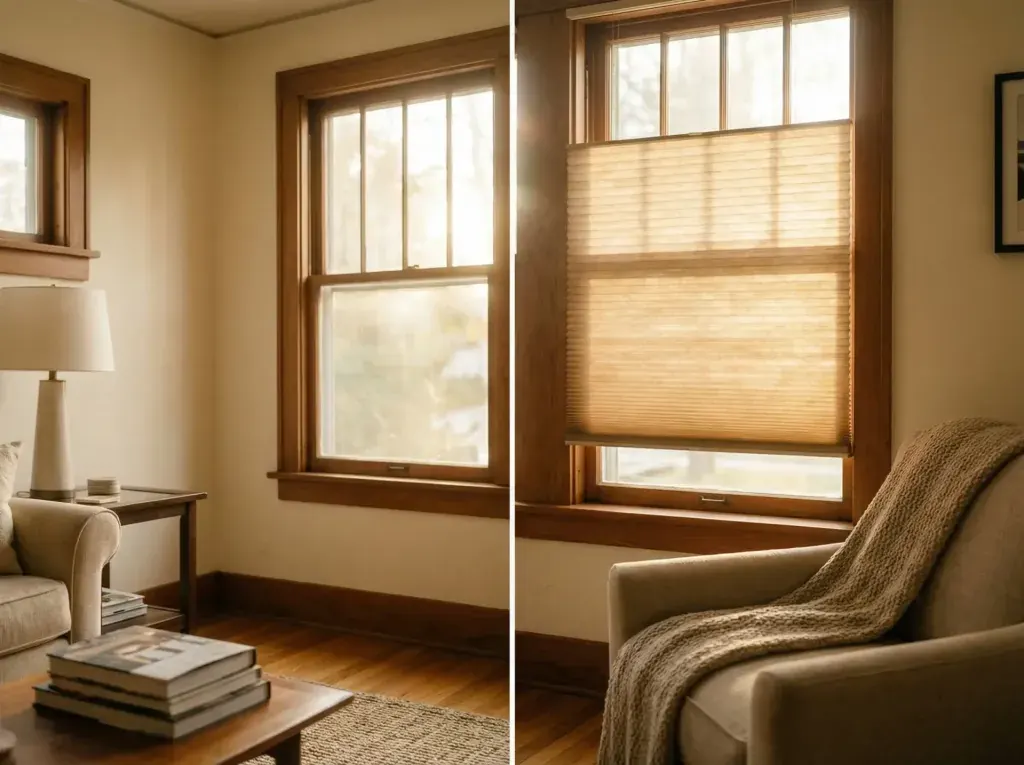
Most cellular shade disappointment in Avon traces back to an assumption nobody checked, that room darkening fabric alone makes a room dark, that double cell is worth it on every window, that a fast delivery date is automatically good news, or that a low quote is the same shade as a higher one. Here are the mistakes that show up most often, and what to ask instead.
What the Cells Actually Do
Before you compare fabric samples for an Avon home, understand what you are actually buying. A cellular shade is pleated fabric folded into rows of hollow tubes, and the trapped air inside those tubes is what slows heat moving through the glass in both directions. Ask whether you are looking at single cell or double cell, since that is the spec doing the real thermal work, not the color.
Ask to see the published R-value for the fabric you are considering, and treat it as real but general information rather than a guaranteed number for your specific Avon home. It is a fair way to compare two fabrics against each other, not a prediction about next month's bill.
Confirm which windows in the house actually take direct sun, since that is what decides where the extra cost of a heavier cell structure is worth paying.
Opacity and the Light Gap
The biggest mistake on this list is assuming room darkening fabric alone produces a dark room. It does not. The fabric blocks light passing straight through the weave, but light comes around the shade at the edges of an inside mount, where the factory has left a small gap on purpose so the shade can move without rubbing.
That gap is why a bedroom can have a fully opaque shade and still show a bright outline every morning. The mistake is not choosing the wrong fabric. It is skipping the side channels or the outside mount with real overlap that actually closes the gap.
The reverse mistake is ordering room darkening in a home office or a kitchen where it is not needed and mostly just leaves the lights on all day. Light filtering does the glare and privacy job in those rooms without going dark.
Single Cell or Double Cell
Double cell is the clearest cost lever on a cellular shade order. It puts two rows of cells front to back instead of one, which means more fabric and more forming, and a finished product that runs thicker and stacks taller once raised. That added cost is worth paying on the openings that work hardest in an Avon home: a west facing wall, a room over a garage, a window that never seems to hold a comfortable temperature, or any wall with more glass than usual.
On the windows that are not doing hard duty, an interior hallway or a small bath, single cell delivers the same look for less money. Cell size, a separate spec running from 3/8 inch up to 3/4 inch, does not move the price nearly as much as cell count does, so choose it for how it looks rather than worrying it will blow the budget.
Buying double cell everywhere in the house is the most common way people overspend on this product. Reserve it for the rooms where the sun actually earns it.
What Cellular Shades Cost
Stock cellular shades run roughly $60 to $600 a window nationally. Custom shades measured in your Avon home and installed run roughly $250 to $2,600 a window based on national ranges. Double cell, room darkening liners, top down bottom up, and side channels move you up inside that band.
The difference between stock and custom is fit more than fabric quality. Stock shades come in fixed widths, usually stepped in half inch increments, and your opening is rarely a round number at the top and the same round number at the bottom. Custom shades get built to the number the tape measure actually found.
Lead times typically run two to five weeks, so plan around that rather than around next week. If you are motorizing anything, ask about battery life up front. A wand commonly needs fresh batteries something like once a year under normal use, a small chore on a few windows and a real annual task on a houseful of them.
Cellular shades work best when someone explains the limits before you buy. There is a light gap on an inside mount. Double cell is thicker and stacks taller than single. Avon Window Treatments measures each opening in your Avon home and tells you what you will actually see. We are insured and bonded. Call (317) 854-7158 to get started.
How the Shade Operates
Nurseries and kids rooms want cordless without any real discussion, since there is no reason to put a corded shade anywhere a small child sleeps or plays. A spring motor in the headrail holds the shade at whatever height you leave it, with nothing hanging loose.
Street facing bedrooms and any dining room that looks straight at a neighbor are where top down bottom up earns its cost. Dropping the top rail a foot or two brings in daylight above eye level while the lower part of the window stays covered, and people who have this feature tend to use it daily.
Home offices care about glare on a screen more than heat or privacy, and light filtering fabric with top down bottom up handles that well, blocking the band of sky hitting a monitor while leaving the rest of the window open. A great room with tall windows twenty feet up is exactly where a motor stops being a luxury, since nobody wants an annual ladder trip to swap batteries at that height.
Frequently Asked Questions
Do cellular shades help in summer or only in winter?
Both, and that matters in this climate, since there's a real cooling load in summer and a real heating load in winter here. In summer, the trapped air inside the cells slows heat radiating off hot glass into the room. In winter, it slows warm room air from giving up its heat to cold glass. Manufacturers publish an R-value for cellular fabric, similar to what's used for wall insulation, and it rises when you move from single cell to double cell. Treat that number as a fair way to compare two shades against each other, not a guaranteed number on your utility bill.
How do you clean honeycomb shades?
Gently and regularly. The cells trap dust, so the routine job is a vacuum with a brush attachment on the lowest suction, run along the pleats rather than across them. Spot clean marks with a barely damp cloth and let the shade dry fully open. Don't soak a cellular shade or run it through anything, since water breaks down the bonds holding the cells together, and a collapsed cell doesn't come back. Kitchen shades need this more often than the rest of the house.
Do I need a different cell size for a small window versus a large one?
It helps to scale it. A 3/4 inch cell on a small bathroom window can look coarse and out of proportion, like a piece of hardware rather than a fitted shade. A 3/8 inch cell on a tall stairwell window turns into dozens of tight pleats that read busy from across the room. The 9/16 inch size is the workhorse that looks right on almost anything in between, which is why it shows up on so many orders. If you're doing several windows in the same room, matching the cell size keeps them looking related rather than random.
 Bay and Bow Window Shades: An Avon Homeowner's Guide
 Window Treatments That Actually Hold Up in an Avon Bathroom
 How to Measure Your Own Windows for Blinds or Shades