Wood Blinds

Wood Blinds Across Avon, IN

Basswood for the rooms with stained casing

Call (317) 854-7158Get Free Quote
Quick Answer

Read these before you choose a fabric. Material, mount and lift decisions constrain what fabrics make sense, and working in that order avoids falling for something that won't work in the room.

  • Service: Wood Blinds for Avon homeowners
  • Service area: Avon, IN and surrounding areas
  • The measure gets scheduled quickly. The build does not, because your fabric or shutter panel is cut to your numbers after you order. Two to five weeks is normal. Service calls skip that step entirely.
  • Insured and bonded
  • Serving Avon, IN since 2008
Wood Blinds Services

Expert Wood Blinds for Avon Homes

Real wood belongs in the part of Avon that has real trim. Timber Bend is brick on every home with cedar and stone accents, averaging 3,412 finished square feet above grade, and Cedar Bend carries five architectural vocabularies inside 52 lots, running from English Tudor to Craftsman. Those interiors have stained casing that a painted slat can't answer. The older Prestwick sections, platted around a course that opened in 1974, are the other place we specify it: pre-1980 stock in central Indiana generally carries applied wood casing and a reveal deep enough to take a 2 1/2 inch basswood blind on an inside mount without a build out.

Wood moves, and Avon's calendar moves it twice a year. Humid air from about May 25 to September 22 swells basswood, then a heated winter averaging a 36.1 degree January high dries it back down. Over a kitchen sink or inside a bathroom that cycle shows up as cupped slats and joints opening at the ends, so we won't sell it there no matter how well it would match the cabinets. Same answer for the below grade rooms in Timber Bend, where 55 percent of homes have a basement. Stain is the second caution: every board takes color differently, and a blind ordered next spring won't be an exact match to this one.

When to Call

Signs You Need Wood Blinds

If you notice any of these in your Avon home, it is worth booking a measure. None of it is urgent, and none of it fixes itself either.

The bedroom blind creeps down overnight on its own

Water spots have dulled the finish along the bottom rail

You added a room and the stain no longer matches

Tilt cords slap the slats every time you let go

Route holes ruin an otherwise good stained blind

Cloth tapes on the existing blinds have frayed through

Old slats have lightened on the sun side only

You're matching window blinds to a stained stair rail

One corner of the opening sits visibly lower than the other

Stained casing deserves better than a white vinyl blind

Our Process

How Avon Window Treatments Handles Wood Blinds

Every job follows the same five-step process. Transparent, thorough, and done right the first time.

1

Diagonal square check

2

Species and slat size chosen

3

Slats leveled at install

4

Stack height estimated with you

5

Old units and packaging hauled off

Real Project Photos

Wood Blinds in Avon

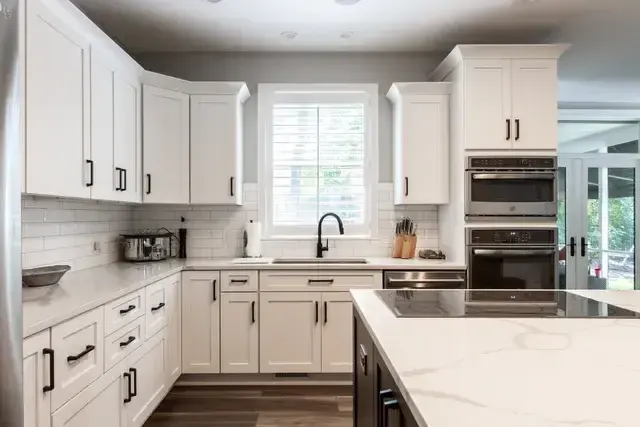
Photographs from real wood blinds jobs completed by our crew in Avon and surrounding areas.
Custom shades measured and installed in AvonPlantation shutters fitted to a Avon windowCellular shades in a Avon living room
Scope of Work

What Wood Blinds Includes

Every Avon job is documented item by item. Here is what the crew covers.

Room-by-room check that every opening stays conditioned all year before wood goes onto the order

Wet rooms ruled out in writing, because a bath or a window over a sink is a faux wood job

Three widths and three heights per opening, plus a diagonal check for square

Mounting depth measured so the headrail sits fully inside the opening where an inside mount is wanted

Basswood specified as the working standard, with heavier species used only where the grain has to carry a room

Slat size chosen against the opening height and the weight of the existing casing

Wider single spans priced without a support bracket, since wood weighs less per foot than composite does

Stain or paint matched from a physical sample held against your actual trim in your actual light

Grain variation and color drift across a stained order explained before anything gets signed

Cloth tape ladders selected where a woven band suits the room and hides the route holes

Routeless construction offered where a line of lit holes would bother you at night

Valance profile and return depth chosen to sit correctly against existing millwork

Wand tilt set as the default, with cord tilt only where a wand fouls a handle or a return

Cordless lift specified in bedrooms, stairwells and any room children use

Products specified to conform to ANSI/WCMA A100.1-2022 for cord access

Light gap per side disclosed at the measure and carried onto the paperwork

Written contract with scope, dates and total price, as IC 24-5-11 requires on residential work over $150

Slats leveled and both full tilt travel and full lift travel tested at every window on install day

Pricing

What Wood Blinds Cost in Avon

Published national figures for the category put stock blinds and shades near $60 to $600 a window, with custom-fabricated product running roughly $250 to $2,600. Those are national ranges and they aren't a quote for a house in Avon. Real wood sits above faux wood in that band and it should, because you're paying for a milled hardwood slat and a finish that has to look right next to your existing trim. Size drives the number first. After that it's the finish: a stock stain costs less than a color matched to millwork, and a matched finish sometimes means a sample run before production. Cloth tapes, a deco valance and routeless slats each add. Avon Window Treatments prices from measured openings in Hendricks County, never from an average.

By Product

How Wood Blinds Differ by Product

Every product in this trade behaves differently in a room. Here is what that means for this work.

2 inch basswood slat: Our working standard in real wood. Basswood is light for its stiffness, which is exactly what you want in a lift mechanism, and the 2 inch slat suits the openings and the casing we find in most central Indiana houses.

2 1/2 inch basswood slat: The same species with a wider face, so fewer slats cross the opening and the view out improves when they're tilted open. It suits taller windows and rooms with substantial casing, where a narrow slat starts to look busy against the trim.

Heavier hardwood species: Some lines offer denser woods that take a stain with more figure than basswood shows. They cost more and they weigh more, so we reserve them for a room where the blind is meant to be looked at rather than looked through.

Stained finish: A transparent finish that lets grain read through, which is the reason to buy wood at all. Expect variation from slat to slat, because that's the wood talking. We hold a physical sample against your trim before committing anything to an order.

Painted finish: An opaque finish in white or an off-white, which gives you wood's light weight and a face that reads as painted millwork. It's the right call when the blind should disappear into the trim instead of standing apart from it.

Custom color match: The factory matches a finish to a sample you supply, usually a piece of your casing or a stair part. It adds cost and time, sometimes a sample run before production, and it's the only honest way to hit an existing stain.

Cloth tape ladders: A woven tape running down the face of the blind that covers the route holes and adds a color band. On a stained wood blind it's a strong design move, and it narrows the view a little wherever a tape crosses the slats.

Routeless wood slats: The lift cord sits in a notch at the back edge instead of a punched hole, so a closed blind has no line of bright dots across it. In a bedroom with a streetlight outside, that's the difference people actually notice.

Crown or deco valance: A shaped valance with a deeper face than the standard flat one, meant to read as trim rather than as a cover for hardware. Choose it where the casing is heavy enough that a plain valance would look thin against it.

Cordless lift: A constant-force spring in the headrail with no lift cord on the blind at all. Wood's lower weight makes cordless feel better here than it does on composite, and it's what we put in bedrooms and anywhere along a stairwell.

Common Questions

Wood Blinds FAQ

Questions we hear most often from Avon homeowners considering wood blinds.

Bathrooms first, then laundry rooms, then anything below grade, then a three season room on the unheated side of the house. Avon's muggy season runs about four months and the heating season is long enough to dry wood right back out, and hardwood slats respond to that with cupping and joint separation. Cedar Bend is 67 percent basements and Timber Bend 55 percent, so on those two streets alone there's a whole second tier of openings where we specify composite instead. Everywhere else in a conditioned Avon house, basswood behaves well and looks like nothing else does.
We can get within a stain sample, and we bring physical samples to hold against your casing rather than working from a screen. What we can't promise is a lumber match. Basswood takes stain unevenly by board, so two blinds from the same order can differ slightly and a blind ordered a year later can differ more. In a 52-lot subdivision where five different architectural styles are represented and no two houses share a plan, the practical approach is to order every stained trim room at once, and where a room won't match cleanly, go a shade darker on purpose so it reads as intentional contrast.
Around six feet is where we start asking questions, and past eight feet the answer is almost always two blinds on a shared headrail. Basswood is lighter than PVC per slat, which buys some room, but a wide blind still reaches the point where raising it is a two hand job and the lift cords wear faster at the cord lock. In Prestwick, where the 1970s and 1980s sections carry wide picture windows and the newest Parks at Prestwick homes carry current production sizes, we've met both extremes under one neighborhood name. Splitting also lets you leave half open and half closed, which people use far more than they expect to.
It depends on the distance, and Avon gives us a lot of chances to find out. Austin Lakes reports fireplaces in about 75 percent of homes, and in those 1990s plans the flanking windows often sit in shallow niches close to the firebox. Direct radiant heat on one face of a slat dries it unevenly, which is the exact recipe for a bow. If the window is within roughly two feet of the opening we specify composite for that pair and keep basswood everywhere else in the room. Those niches also cut mounting depth, so the depth question and the heat question usually arrive together.
Closure and stack. The wider slat overlaps more when tilted shut, so it blocks more light through the body of the blind, and it needs fewer slats for the same drop, which means a shorter stack at the top when you raise it. The tradeoff is scale. On the 1,712 square foot average house at Avon Trails a 2 1/2 inch slat overwhelms a small window; on a Timber Bend great room averaging well over 3,000 square feet above grade it looks correct. Route holes leak light on both sizes, which is why we don't sell either one as a room darkening solution.
It changes, and the honest word is slowed rather than stopped. NFRC attributes roughly 40 to 60 percent of fading damage to ultraviolet light, and the rest comes from visible light and heat, so no window covering removes the problem entirely. A stained basswood slat on a south or west elevation will lighten over years, and it lightens on the exposed face only, so the difference shows when you tilt the blind. Painted white slats yellow instead. Where a room takes full unbroken sun, such as the pond facing side at Bridgewater, we pair the blind with a solar shade so the wood spends most of the day in shade.
Because wood answers moisture by moving, and a bathroom gives it plenty to answer. A slat that takes on humidity swells slightly across its width, then gives that moisture back when the room dries out, and after enough cycles it doesn't come back straight. You get cupping along the slat and a blind that stops closing evenly. Faux wood has no fiber left to swell, so it does that job instead. In a white blind, from across the room, you'd have a hard time telling which is which anyway.
It runs it through two opposite conditions. The muggy stretch here goes from late May into late September, so a wood slat spends about four months taking on humidity. Then the heat comes on, indoor air gets dry, and the same slat gives that moisture back over a heated winter. In a conditioned room that cycle is mild and the blind is fine for years. In a room that swings, a sunroom or an unconditioned porch, it's the cycle that eventually takes a slat out of flat.
For most of what we hang, yes. Basswood is stable, mills cleanly, and it's light for its stiffness, which matters more than people expect. Weight is what a lift mechanism fights, and a lighter slat means a wider blind can work as one unit and a cordless lift feels smoother in the hand. Denser species exist and they show more figure under a stain, but they cost more and they add weight. We use them where a room is really about the look of the wood.
Usually close, sometimes exactly, and never from a screen. We bring physical samples and hold them against your casing in the light that room actually gets, because a stain that looks right under a showroom lamp can read orange at four in the afternoon. If nothing in the standard range lands, a custom color match sends a sample of your trim to the factory. That adds cost and time. It's also the only method that gets you there, so we'd rather quote it honestly up front.
Because it's wood. Grain runs differently through each piece, stain sits into open grain more heavily than into tight grain, and a slat cut from one part of a board takes color a little differently from its neighbor. On a stained blind that variation is the product working as intended, not a fault. If you want a face with no variation at all, a painted wood blind or a composite slat is the honest way to get it, and we'll say so before you order.
Wood is fine there as long as the room stays conditioned, which a living room does. What you should know is that a stained wood slat sitting in direct afternoon sun will lighten over years, and it lightens on the sun side more than the shaded side, so a wide window can end up reading unevenly. NFRC puts UV at roughly 40 to 60 percent of fading damage. Tilting the slats up bounces the direct sun toward the ceiling and slows the change. It doesn't halt it.
Wider than the same blind in composite, which is one of the practical arguments for wood. Every manufacturer publishes a maximum width and a maximum square footage, and those limits are really weight limits. Basswood weighs less per running foot than a faux wood slat of the same size, so a span that would want a center support bracket or a two-on-one headrail in composite can often stay a single unit in wood. We check the actual numbers against your measured opening before ordering.
They're woven tapes that run vertically down the face of the blind, covering the route holes and carrying a color band. Mechanically almost nothing changes, since the ladder still holds the slats and the lift still runs the same way. What changes is the look, quite a lot, and the view, slightly, because each tape sits across the slats and blocks a narrow strip when they're open. Frayed tapes on an old blind are one of the common reasons people replace an otherwise working unit.
On a tall window the wider slat usually wins. Fewer slats cross the opening, the face reads calmer, and the view between open slats is better, which matters more the more window there is. The 2 1/2 inch slat also suits heavier casing, and older houses in Avon often have casing worth respecting. Where we go back to 2 inch is a short window, a transom or a room with delicate trim, since a wide slat there swamps the opening it's sitting in.
They slow it, and that's the accurate word. NFRC attributes roughly 40 to 60 percent of fading damage to UV, with the rest coming from visible light and heat, so no window covering ends the problem outright. A closed wood blind is an opaque layer, which does more than a sheer fabric, and tilting the slats upward on a sunny afternoon keeps direct sun off a hardwood floor while the room stays usable. That's a real reduction in exposure rather than an end to it.
You can order more, and you should expect a small difference. Stain lots vary, wood varies, and a blind built next year comes from different boards than the ones hanging now. Across a hallway nobody sees it. On two windows in the same wall it's obvious. The practical answer is to order a room complete rather than half of it, even where a window seems low priority. We write the exact finish name onto your paperwork so a later order at least starts from the right reference.
Dry first, always. Close the slats one direction, run a dry microfiber cloth or a vacuum brush across the face, then close them the other way and repeat. For a mark that won't dust off, use a barely damp cloth and dry it immediately. Don't soak a slat, don't use a spray cleaner across the whole blind, and never put a wood blind in water the way people sometimes do with vinyl. Cloth tapes want a soft brush rather than anything wet.
In a bedroom or along a stairwell, yes. There's no lift cord on the product at all, which is the direction the ANSI/WCMA A100.1-2022 work on cord access points, and inner-cord non-compliance is treated as a substantial product hazard under 16 CFR 1120.3. Beyond that, a cordless wood blind is simply nicer to use every day, and wood's lighter weight makes the mechanism feel smoother than it does on a heavy composite unit. On very wide blinds we still talk through whether motorization is the better answer.
Custom fabrication runs two to five weeks in this trade, and stained wood tends toward the longer end because finishing is a separate step at the factory. A custom color match adds more, sometimes a sample run before production even starts. None of that is a delay. It's a factory milling and finishing slats to sizes taken in your house. You'll get the window in writing with scope, dates and total price, which the Indiana Home Improvement Contract Act requires on residential work over $150.
Areas We Serve

Wood Blinds Across Avon

We measure and install in every one of these Avon neighborhoods. Each has its own page with the build eras, window conditions and mounting notes for that section.

Free In-Home Measure

Schedule Your Free In-Home Measure in Avon

Contact Information

Reach Us Directly

Our team prioritizes scheduled measures and service calls, and books in-home measures during business hours.

Office
1417 Commerce Avenue, Indianapolis, IN 46201
Hours
Mon-Fri 8a-6p
Service Area
Avon, IN and Surrounding Areas

Ready to Book Your Measure?

Call us to set up an in-home measure, or to ask about a treatment that has stopped working. We will talk it through on the phone first.

Service area

Serving Avon and the surrounding area

Call NowGet Quote