Retractable Awnings in Avon: How to Size and Mount One
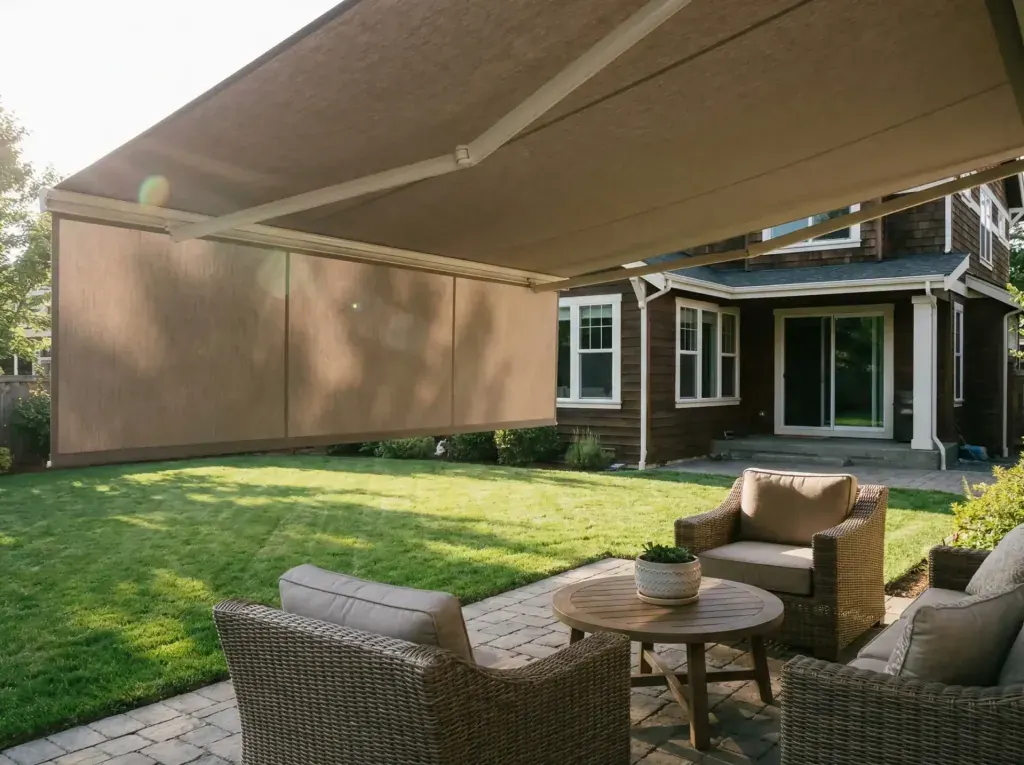
Manual and motorized awnings do the same job in completely different ways, and the choice matters more than most people assume before they've owned one through a real storm season. This walks through what actually changes between the two, from the cost on the invoice to what happens on an Avon evening when the wind picks up and nobody's outside to crank a handle.
Sizing an Awning: Width and Projection
The most common sizing mistake is measuring the wall instead of the furniture underneath it. A table and chairs need roughly ten feet of depth to stay covered, since people push back from the table when they sit, and a lot of Avon homeowners order less projection than that and end up with sun on their plates by six o'clock.
A related mistake is forgetting that width, how far the unit runs across the wall, has to exceed projection, how far it reaches out, on nearly all lateral arm units. The arms need room to fold, so a narrow stretch of wall simply caps how far out the awning can go regardless of what gets ordered.
Mounting too low causes a similar problem from a different angle. The awning pitches downward as it extends, typically 15 to 25 degrees, so a low bracket with a long reach puts the front bar right at head height.
Living With an Awning Through the Seasons
An awning earns its keep from late May into the back half of September here, when a west facing patio can go from pleasant to unusable right around four in the afternoon. Spring and fall are the underrated months. An awning extends both shoulder seasons by cutting glare and taking the edge off a bright, cool afternoon, and plenty of Avon homeowners end up on the patio more in May and October than they expected.
Fall is also when the season's real work happens. Extend the awning fully on a dry, breezy day and brush off debris with a soft brush, skipping the pressure washer, which can drive water into the seams. Spot clean any marks with mild soap and cool water, then let it dry completely before rolling it back up. Retract it only once it's fully dry, since fabric put away damp for the winter comes out mildewed in spring, and cut power to a motorized unit for the season so nothing extends it into snow by accident.
Spring startup is quick: check that both arms extend evenly and that the front bar sits level before the first real weekend outside.
Get the projection right for the furniture you actually use, and put the anchors into something structural. The wind sensor is worth adding too. Those decisions carry the job, and everything else is preference. Avon Window Treatments looks at the wall before quoting anything, and we're insured and bonded, with the mounting detail written into the scope. Call (317) 854-7158 and we'll come out and measure the patio.
Manual or Motorized Operation
A tubular motor with a remote is the single biggest optional line on the invoice. Hardwiring adds an electrician's time on top of the motor itself, while battery and plug in options skip that circuit run and cost less installed. Manual units use a gear box and a crank handle instead, and they're the cheaper choice up front by a real margin.
The motor is worth defending anyway. A manual awning takes a minute or two of cranking each direction, so it tends to get left out through weather it shouldn't sit in. A motorized one gets retracted because retracting it takes seconds, and that protects the arms and the fabric, both of which cost more to fix than the motor cost to add.
A wind sensor is a modest add against the price of the unit it protects, and it's the easiest upgrade on this list to justify.
Fabric Choices and What They're Made Of
Fabric choice doesn't depend on manual versus motorized, but it deserves equal attention either way. Solution dyed acrylic carries pigment through the fiber itself rather than on the surface, since the color gets mixed into the liquid acrylic before the fiber forms, and that slows fading noticeably compared with fabric dyed after weaving. It also breathes, letting hot air move through instead of collecting underneath on a still Avon afternoon.
Vinyl coated polyester is waterproof rather than water resistant, which sounds like an upgrade, and in a downpour it is: water sheets right off. But it holds heat underneath and can turn brittle in a hard freeze. Piece dyed fabric is the budget tier, and it tends to look tired within a couple of summers regardless of which operation style sits above it.
What Drives the Price and What the Wall Has to Hold
Nationally, a retractable awning installed on a house runs roughly $1,000 to $6,000, and the spread is wide because a ten foot manual unit and an eighteen foot motorized one with sensors are barely the same category. Size, motor, hood type and fabric grade all move the number, and mounting conditions matter as much as any of them.
An extended awning is a long lever, and wind pulls up on it as hard as it presses down, so the anchors matter more than the awning itself. Solid masonry takes heavy sleeve or wedge anchors set into the mortar pattern a manufacturer specifies. Brick veneer over a frame wall is a facing, not structure, so fasteners have to reach the rim board or blocking behind it. Stucco carries nothing at all, and the bracket has to land on framing behind it. Older Avon homes throw curveballs here, from balloon framing to a band board that isn't where you'd expect, which is why a site visit happens before an order, not after.
Frequently Asked Questions
Manual or motorized?
Manual is reliable and costs less, and it needs no power to operate. The catch is behavioral: a couple of minutes of cranking in each direction means the awning tends to stay out through weather it shouldn't. Motorized units use a tubular motor inside the roller tube, with travel limits set at install so it stops in the same place every time. Battery and plug in options skip running a circuit. If the awning is wider than about twelve feet, most people end up wanting the motor.
Do I really need a wind sensor?
It's the accessory worth arguing hardest for. Wind is what destroys retractable awnings, and it rarely happens while anyone's standing under it. A wind sensor reads movement at the arm or the front bar and retracts the unit automatically once it crosses a threshold you set. It costs a small fraction of the awning and protects the arms, which are the expensive part to replace. If you're gone most of the day, treat it as close to required.
What is solution-dyed acrylic and why does it cost more?
The pigment is mixed into liquid acrylic before the fiber is formed, so color runs through each fiber rather than coating the outside. Sun wears the surface of any fabric, but with color running all the way through, fading is slowed rather than showing up as a washed out patch after a couple of summers. Acrylic also breathes, so hot air passes through instead of building up under the awning. Cheaper fabrics get dyed after weaving and look tired much sooner.
 Bay and Bow Window Shades: An Avon Homeowner's Guide
 Window Treatments That Actually Hold Up in an Avon Bathroom
 How to Measure Your Own Windows for Blinds or Shades